Showing posts with label bread. Show all posts

Thursday, October 22, 2020

Barm Brack

Barm Brack.  Photo by fordmadoxfraud, 
found on Wikimedia Commons
While surfing the Internet recently, I learned about a quick bread from Ireland that I might like even better than Irish soda bread--barm brack.  Barm brack, or barmbrack, or simply brack, has strong associations with Halloween, which makes it a good topic for an October post. 

Barm brack is an Anglicized spelling of the Irish Gaelic term bairín breac.  Barm brack is a quick bread made with self-rising flour, which typically contains baking powder.  Unlike Irish soda bread, barm brack contains dried fruit--raisins, sultanas, currants, candied peel--as well as sugar and spices like cinnamon. Recipes contain different amounts of dried fruit.  Some contain so much dried fruit that barm brack has been referred to as "Irish fruitcake".

The Halloween connection comes from the fact that this bread (or cake, as the Irish were wont to refer to a sweetened baked good) was, like the King Cake of Mardi Gras, baked with a surprise inside.  The surprise in a King Cake is a bean or figurine and finding it in your slice earns you a temporary, small privilege.  

Barm brack contains multiple trinkets, and the nature of the trinket you find supposedly tells your fortune in the coming year.  Wikipedia reports that a barm brack could contain:

a pea, a stick, a piece of cloth, a small coin (originally a silver sixpence) and a ring. Each item, when received in the slice, was supposed to carry a meaning to the person concerned: the pea, the person would not marry that year; the stick, would have an unhappy marriage or continually be in disputes; the cloth or rag, would have bad luck or be poor; the coin, would enjoy good fortune or be rich; and the ring, would be wed within the year.

The Welsh make a similar bread called bara brith or "speckled bread," from all of the raisins or pieces of dried fruit inside.  Unlike barm brack, it does not seem to have fortune telling or Halloween associations. The Irish and Welsh breads both involve soaking the dried fruit in strong tea before adding it to the dough.  

I've long had a weakness for raisin bread.  Which is why I seldom buy it--I have no desire to become even more loaf-shaped than I already am.  But barm brack and bara brith sound distinctive enough to be interesting.  I might make some for experimental purposes, sometime.  

Wednesday, April 3, 2019

Boston Brown Bread

Boston brown bread, served with cream cheese.
Found on Wikimedia Commons, Author (?) jeffreyw
Ever since I can remember, I have been fascinated by recipes.  As a young child, I enjoyed reading cookbooks to get more of them.  Sometimes, I still do.  It's a great way to enjoy more food than you can eat without actually overeating.

Anyway, I was looking on the Internet for baked bean recipes to cook (not just because they make interesting reading) when I spotted a reference to something called "Boston brown bread."  Since I'd never heard of it, I went to Wikipedia to track down some basic information about this tasty-looking item. 

According to Wikipedia, Boston brown bread is a sodium bicarbonate quick bread--like Irish soda bread.  Unlike Irish soda bread, Boston brown bread is made with both whole wheat flour and rye flour, and sweetened with molasses--hence its brown color.  It is considered the traditional accompaniment to baked beans, which is why it was referred to in the baked bean recipe I was reading.  

The Food Timeline has some interesting information about this bread.  It cites Boston brown bread as an explicit example of the phenomenon I referred to in my soda bread post.  First, a simple home-cooked food item is simply food for the poor.  As time goes on, that food acquires an aura of healthiness, because it is so basic.  Eventually, it becomes an item made and sought out by "foodies" for its culinary values other than nutrition (e.g., healthiness, flavor).

Boston brown bread often included corn meal--like rye and whole wheat, another cheap flour that could be exploited by the poor to make their meals more interesting. In fact, the same bread, minus the raisins, was called "Rye and Indian" or "Rye and Injun" bread because rye flour and cornmeal were its main ingredients.  Another variant, "thirded bread", was made with equal parts of rye flour, whole wheat flour, and cornmeal.  All of these were thought of as "make do" breads by the folk who lived on them, and were quickly abandoned by most once white bread became cheap.

Unlike soda bread, which was either baked or pan fried, Boston brown bread was often steamed in a container, such as a coffee can.  The Food Timeline claims that this is because early New England houses didn't have ovens.  Instead, they used a fireplace for cooking, and "[s]teaming was an effective way to make bread without an oven."  It also results in a food that looks a lot like what the British still call a "pudding"--a steamed bread, often with raisins or other sweet additions.

Because it's steamed, Boston brown bread is ideal for the slow cooker--all you need is a suitable container to steam the batter in.  I hope to experiment with some recipes for it later this year.

Sunday, March 17, 2019

Irish Soda Bread

Whole wheat soda bread.  Photo taken by Heather "Moria"'
Found on Wikimedia Commons.
My husband has often remarked that certain foods that have become beloved of foodies started out as everyday foods, cheap enough to make for the poorest of families.  

A great example of this phenomenon is Irish soda bread.  If you look on the Internet, you will find great numbers of soda bread recipes.  Some have caraway seeds.  Others don't.  Many have raisins or currants, or added sugar, or butter. There are even a few that can be made in a slow cooker.

If the soda bread of your dreams has any of these extras, it is inauthentic, according to the website of The Society for the Preservation of Irish Soda Bread ("the Society"). This organization, started by Irish immigrant Ed O'Dwyer, attempts to set the record straight about the real Irish soda bread.

The real Irish soda bread, as befits a food affordable even by the poor, had only four ingredients:  baking soda, wheat flour, buttermilk, and salt.  Any other additions turn it into a fancy dish for respected company.  Irish soda bread with raisins or currants and sugar is more like a tea cake, according to Mr. O'Dwyer.

On the other hand, the baking soda is essential; it's what makes this quick bread rise.  When sodium bicarbonate (the chemical name for baking soda) reacts with an acid, it releases carbon dioxide which causes the bread to rise.  Buttermilk, which is acidic, performs this function for Irish soda bread.

The Society's website states that the earliest reference they have found is from the Farmer's Magazine (London), Vol. 5, page 328, November 1836.  The Farmer's Magazine article cited an unnamed correspondent of the Newry Telegraph, a newspaper in County Down, Ireland, as giving the following recipe for it.
He says, "put a pound and a half of good wheaten meal into a large bowl, mix with it two teaspoonfuls of finely-powdered salt, then take a large teaspoonful of super-carbonate of soda, dissolve it in a half a teacupful of cold water, and add it to the meal; rub up all intimately together, then pour into the bowl as much very sour buttermilk as will make the whole into soft dough (it should be as soft as could possibly be handled, and the softer the better,) form it into a cake of about an inch thickness, and put into a flat Dutch oven or frying pan, with some metallic cover, such as an oven-lid or griddle, apply a moderate heat underneath for twenty minutes, then lay some clear live coals upon the lid, and keep it so for half an hour longer (the under heat being allowed to fall off gradually for the last fifteen minutes,) taking off the cover occasionally to see that it does not burn.
The Food Timeline, in turn, points to recipes for soda bread from roughly the same period, including one from 1829 that includes raisins, currants, sugar, sweet almonds, and candied orange peel.  That recipe, however, was clearly intended for a festive occasion, as Mr. O'Dwyer says, since the recipe's source identifies it as "the holiday cake of Munster."

My personal acquaintance with soda bread came from that palace of conspicuous consumption, America's favorite supermarket, Wegmans.  Wegmans' version of soda bread contains raisins and a bit of sugar, and adds barley flour and rye flour as well as palm oil (substitute for butter?) and several milk products, possibly meant to take the place of the buttermilk.  I like this bread so much that I'm grateful that they only sell it around St. Patrick's Day, or I'd eat it to excess far too often.  But now that I know how inauthentic Wegmans version is, I'm tempted to use my slow cooker to try out a more authentic recipe, just to see how well I like it.  Or maybe I should try making it in a skillet, which is is more traditional (as the Newry Telegraph noted).

Tuesday, July 17, 2018

Stone Age Bread

This seems to be a month for discoveries relating to Stone Age food.

This article from The Independent, a British newspaper, reports on an archaeological find from Jordan that goes back approximately 14,000 years, to the Upper Paleolithic period of the Stone Age.

In a surviving fireplace at a site called Shubayqa 1, archaeologists from the University of Copenhagen found a piece of flatbread, made with a strain of wild, uncultivated wheat--approximately 3,500 years before the beginnings of agriculture.  The researchers stress the fact that, given the relatively poor nutritive value of this strain of wheat, the work involved in making the wheat into bread would not have made it more nutritious.  Instead, they believe that the flatbread was made for a special communal meal--a forerunner of communal meals eaten in the same region of the world today.

Also of interest is the fact that, although barley was the most common cereal plant in the Near East at that time, the food maker chose to use wheat.  This may well have been because wheat contains more gluten, and dough made from wheat rather than barley can be more easily used to make bread.  Moreover, wheat can be used to make much thinner flatbreads than barley.  

The researchers believe that this discovery tends to show that cuisine--the creation of more interesting foods to be eaten for social purposes as well as for mere sustenance--came before agriculture, not the other way around.  

The researchers' report on the find will be published in the Proceedings of the National Academy of Sciences, should any of readers of this blog be motivated to track down the actual report.

On a side note, the observation that the Stone Age residents of Jordan, despite living in a barley-rich area, chose to use wheat to make flatbread, suggests that I've been going about my Viking flatbread experiments wrong.  Although the Vikings may well have incorporated barley in their bread-making, they probably would have used wheat in their flatbreads, either alone or combined with barley--for the same reason the Stone Age Jordinians used it--because it makes better bread!  My future flatbread experiments will be conducted with this knowledge in mind.

Saturday, October 21, 2017

An Intriguing Answer to the Viking Flatbread Question

If you're like me, you have attempted to make a flatbread that the Vikings might have made.  I've read any number of suggested recipes, but the ones I've tried have led to breads that were too thick, doughy and unappetizing.

Tonight, I found the video to the right of this post, which was produced by a modern chef/blogger/YouTuber who goes by the name "Chef John".  In the video, Chef John wasn't talking about Viking flatbread, or any one ethnic version of flatbread.  He was focusing on technique, not ingredients in any real sense.  He blogs about his technique here. 

Here's what Chef John suggests you do to make flatbread:
  • Dump a quantity of flour (whatever kind of flour you choose to use), approximately sufficient to make as many flatbreads as you want, onto a smooth flat surface (such as a clean flat rock, a smooth board, a clean stone countertop).
  • Make a depression or "well" in the center of your mound of flour.
  • Slowly pour small amounts of water into your well.  Stir the water slowly into the flour.  As the water is incorporated into the flour, add a bit more and continue.  Stop adding water when you have a sticky dough that includes most of your flour.  Continue to mix the dough with your hand until it only sticks a little to your flat surface.
  • Let the dough sit, covered, for about an hour.
  • Remove a chunk of dough, and roll it into a thin disk-shaped piece of dough.  (Chef John points out that you can do this with a wooden dowel of a suitable thickness--you don't need a fancy "rolling pin".)
  • Put the rolled-out dough disk into a flat, UNGREASED pan.  (My guess is that this works best on cast-iron or a non-stick surface.)
  • Cook the dough until it forms bubbles.  Flip it over.  Do this until you have some char marks on both sides.
  • Remove the cooked bread from the heat.
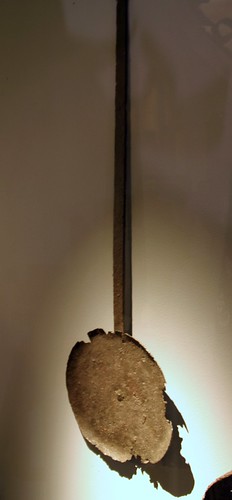
The Vikings had portable griddles--a flatbread-sized iron disk attached to a long handle that it's believed were held over the fire to cook flatbreads.  However, Chef John's technique could have been used with those, too.  

I think this is worth trying out.  I don't think I'll have time to do that this weekend, but Chef John's technique sounds like a better way to make "Viking" flatbread than overly complex efforts to try to deduce the right mix of modern flours or other ingredients to use for a "Viking" flatbread.  One thing that convinces me that this technique might have been closer to what the Vikings did is the fact that it doesn't require measuring quantities or a long list of ingredients.  Best of all (from both my point of view and the way the Vikings likely cooked) is that you can make flatbreads in this way in any quantity from tiny to large, just by starting with more flour or less flour--you add the water bit by bit either way.  

I plan to try this recipe with barley flour first because it's clear that barley was used by the Vikings.  When I get to try this technique out, I'll blog my observations.

EDIT:  2/2/2018  Great minds think alike!  On the Facebook page of a Viking reenactment group based in Canada called Ðrottin I found a video showing the making of flatbread, using a very similar technique to Chef John's! The page can be found here. (You want the "How to Make Viking Style Bread" video.)  The comments on the video did point out that the Ðrottin video uses modern flour, and the Vikings would have access only to quern-ground flour, whether wheat or barley, and such flour would be quite coarse.  I'll try my modern fine barley flour anyway and see what happens.

Thursday, November 10, 2016

Reverse Engineering a Roman Bread Recipe

Carbonized loaf of bread, AD 79, Roman, Herculaneum. 
© Soprintendenza Speciale per i Beni Archeologici di Napoli e Pompei
The 2013 video that appears to the left of this post shows baker Giorgio Locatelli recreating a bread recipe that could have been used to bake the loaf found in the archaeological dig at Herculaneum; a loaf made over 2,000 years ago.  A written version of the recipe may be found here at the British Museum's website, and a picture of the grayish, carbonized loaf from Herculaneum may be found to the right.

Mr. Locatelli believes that the flattish loaf was a sourdough bread.  He believes that its odd shape came from affixing a string around the loaf and making cuts in the surface of the dough mass before baking.   Mr. Locatelli also suggests that the Herculaneum loaf may have been baked with a string tied around the dough so that the finished loaf could be carried by the string; a useful bit of convenience in a place and time in which sellers were not expected to provide buyers with containers for carrying purchases. Interestingly, he does not believe the dough was kneaded much.  Instead, he thinks it was merely mixed thoroughly until it achieved the right consistency and then allowed to rest at room temperature for about an hour before baking.

It makes sense that early leavened loaves would be made from sourdough.  No special equipment is required, and no yeasts need to be isolated for special addition to your flour and water dough.

As for the lack of kneading, About Food suggests that the purpose of kneading is to align gluten strands within the dough into a framework that will make the bread lighter.   A dough that has fermented, however, will have a similar gluten matrix, caused mostly by the fermentation process; it won't need much kneading.  Although one can certainly put a lot of effort into kneading sourdough (and doing so can produce wonderful results, as I learned as a child from my mother's sourdough experiments), it may not be necessary to do so, especially if you are not interested in getting your loaf to rise substantially.

The moral of this story is that anything a person can create, another person can recreate by logical deductions based on specific knowledge of the type of item and the materials and processes typically used to make such items.  That's as true of bread as it is of clothing, hairstyles, machines and computer programs.  It is fascinating to see such recreation techniques applied to food as they have been to other areas of material culture.

Thursday, September 12, 2013

Chemistry First

After the last flatbread experiment, it occurred to me that while tastes and technologies may have changed since the heyday of the Vikings, the relevant food chemistry has not. Thus, it would make sense for me to see what kinds of recipes are used to make modern flatbreads, and then try to adapt those recipes with knowledge of known Viking ingredients and cooking techniques in mind.

It turns out that most of the flatbread recipes I found on line--for naan, ciabatta, pita bread, and the like--all contain an ingredient that causes the dough to rise somewhat either before or during the cooking process. The rising ingredients found in the other flatbreads are either baking soda, baking powder, or yeast.

Baking soda was not, so far as I know, used in food during the Viking age, and baking powder was invented in the 19th century, so that leaves me with yeast as a period rising agent.  Since the Vikings couldn't just visit a supermarket and buy a packet of yeast as the Internet recipes I've seen require, I have but one possibility to consider--sourdough.

I'm surprised I didn't think seriously about the use of sourdough by the Vikings sooner. My mother experimented very successfully with sourdough recipes when she was about my age, and all of her projects (particularly her doughnuts, yum) turned out very well.

Sourdough, as Wikipedia correctly explains, is made by a process that encourages yeasts that are naturally present in flour to ferment your bread dough. Essentially, you make a dough "starter" from flour and water, and in time the natural yeasts present in the flour begin their own fermentation process that results in leavening. Once the starter has reached an appropriate level of yeast activity, you just use a bit of the starter an an ingredient in your bread projects instead of store-bought yeast, periodically adding new flour and water to keep the existing yeast culture in the "starter" going, a process which can continue indefinitely (I think my mother kept our dough starter going for six months before she got tired of making so much bread).
Two sourdough loaves.  Front: 90% white flour, 10% rye sourdough loaf proofed in a coiled-cane brotform. Back: A 3-pound whole-wheat miche.  (Wikimedia Commons)

Use of sourdough would fit with Viking material culture in two other ways as well. First, breads made with sourdough are, as the name implies, slightly sour in taste, and sour tastes were very familiar to the Vikings (such flavors appear in period dairy foods such as skyr, whey, and cheese, to name a few). Second, and perhaps more importantly to a northern farming culture for which food preservation was a major issue, sourdough breads are naturally mold-resistant.  That is a factor that also matters to me personally, because I live in an area where high humidity is prevalent and breads tend to acquire mold quickly.

I cannot recall seeing much discussion of the potential use of sourdough by the Vikings (though A Culinary Journey Through Time includes a sourdough bread recipe).  But this seems like a useful avenue for experimentation.  I think I will read up on the process of making sourdough bread, and try making some pan-fried flatbreads with sourdough instead of simple flour-and-liquid mixtures. 


Tuesday, July 23, 2013

The Origin of Viking Bread?

Between the heat of the last few weeks here and various personal tasks, I have not been very interested in more speculative adventures into recreating Viking Age Scandinavian cuisine.

Bread found in the ruins of Pompeii
I was delighted to learn of this article which discusses a very interesting theory about how bread making came to Scandinavia.  The article is in Swedish, but Google Translate did a very good job of making it intelligible to this English speaker. You can see Google Translate's English version here.

Liselotte Bergström, at the Department of Archaeology and Classical Studies at Stockholm University, has been studying archaeological remains of bread found at Mälarlen, Östergötland, Helgö and Birka, and she has reached some interesting conclusions.

It appears that the earliest finds of bread and bread-making equipment in Scandinavia date to about 200 C.E. Grain likely was eaten by Scandinavians much earlier, but in the form of porridges, not as bread. Bergström's theory is that Scandinavians learned how to make bread from Roman soldiers, possibly from serving with Roman forces as auxiliaries. Grave finds also indicate that bread was associated with male leaders--not females--and was not an everyday commonplace. So far as I can tell from the article, bread finally became a common part of the Scandinavian diet in the Viking age.

According to the article, the early forms of bread were more like small, round rolls, made from a dough consisting of two parts flour to one part water, and cooked in a frying pan over a fire.   The loaf above was found at Pompeii and may be similar to the Scandinavian product (except for the shape).  The idea sounds simple enough to try some weekend when I've gone back to making stew, possibly using barley flour.

The most important thing about Bergström's theory is not that it sheds light on food practices particular to Scandinavia, but that it demonstrates how archaeology can help us learn how such ephemeral tasks as the preparation of our daily bread were learned, and spread.  This kind of research has the potential to enlighten us about the development of cultures in a way that is difficult for written history to match, and it will be welcome to see more such research opening our eyes to the past.

Monday, January 7, 2013

A New Viking Flatbread Recipe and Another Cookbook

Happy New Year!

I've been a bit too preoccupied with my job situation, and with holiday visitors, to dwell on historic cooking projects, but the other day I ran across a blog associated with the Ringkøbing-Skjern Museum, a Danish museum that engages in a lot of Viking lifestyle-re-creation types of projects. The blog published a Viking flatbread recipe they have experimented with. It uses one part wheat flour to two parts rye flour, along with a bit of honey, a small amount of cardamom, and a handful of raisins for flavoring. The flatbread recipe can be found in this entry, and I intend to try it out at my first opportunity, because it sounds tasty (even though I'm not convinced that most Vikings would have had cardamom handy).

 In addition, the Museum's Shop features another cookbook with putative Viking recipes. They describe it as "a cookbook for the modern Viking". The cost is about $30 USD (before postage), but since the book is written in Danish, I don't expect to be purchasing it anytime soon. If I change my mind and obtain a copy, I will write about it here.

Tuesday, May 10, 2011

Hardtack

On the trail of the breads of yore, today a friend of mine passed on a recipe for hardtack which appeared, of all places, on Boing Boing. Hardtack is simple to prepare: here's the recipe in toto:
Mix 2 cups all-purpose flour, 2 cups whole wheat flour, and 1 tsp salt. Form it into a dough using 1.5 cups of water.

Let the dough rest for 10 minutes. Then spread it into a pan, prick it all over on top with a fork, and bake it for 50 minutes at 325 degrees F.
I'm not terribly interested in trying hardtack, which, aside from the texture that earned it its name, has a reputation for becoming wormy. However, according to Boing Boing, this particular recipe comes from a cookbook called The Food Journal of Lewis & Clark: Recipes for an Expedition by Mary Gunderson; Boing Boing claims that the other recipes in that book--which presumably are of late 18th - early 19th century provenance--are much tastier. Now I'm curious about the other recipes in that book; I think I will have to track it down. If I do, I'll write about it.

EDIT: A friend of mine wrote a short article about hardtack noting that it becomes wormy only if it is not absolutely shielded from dampness. It also discusses similar bread products made to have a long shelf life, such as pilot bread. The article may be found here.

Tuesday, March 2, 2010

What Did The Vikings Eat With Their Bread?

My husband and I had another meal of beef and barley stew, with more of the Viking flatbread. (The number of dough balls in the bag doesn't seem to have gone down any, and the quality remains undiminished since the last time I fried some.) Tonight, he had his with maple syrup (very unperiod) and I had mine with apple butter.

Apple butter, though consisting entirely of materials that were available in period, is itself also non-period. The Food Timeline claims that similar preparations go back only to the Middle Ages, and in its present form apple butters are traceable to the Pennsylvania Dutch in the 18th century or so.

That certainly explains how I know about them, since we live close enough to Pennsylvania Dutch country that Amish folk come out to sell their farm goods in our local markets. But it doesn't really answer the question of what the Vikings might have eaten on *their* flatbread.

My husband had one plausible idea; honey. That seems likely to me. The other possibility is skyr, a very soft cheese that was closer to yogurt in properties and flavor; it's mentioned in the sagas. Probably they sometimes combined the two, perhaps adding dried fruit.

EDIT: I take back my comment about the period ingredients in apple butter. Apple butter uses sugar, which likely would not have been available in Scandinavia in period. It sometimes also has spices, including cinnamon, which I don't believe the Viking age Scandinavians had either. Nor do I know whether the basic means of making apple butter--i.e., simmering down seasoned, sweetened apples until they form a paste--works if you use honey instead of sugar. (Though it might be interesting to find out.)

Monday, January 25, 2010

Viking Bread

Making my "Anglo-Saxon" stew after so long a time has made me think about period foods to serve with it.

Since I usually eat stews with bread, the first thing that I thought of was a plausible Anglo-Saxon or Viking bread. (The cultures were contemporaneous in time, after all, and ate many of the same types of foods.)

A casual search revealed this recipe, from the Viking reenactment group Hurstwic. It uses a mix of wheat, oat, barley, and rye flours, and buttermilk. As is consistent from what we know of Viking cooking technology, it's an unleavened bread, cooked on a flat pan (period pans looked like this one now in the Bergen Museum), but one could make the same type of bread in a broad, greased modern skillet).

Of all the "Viking" bread recipes I've seen, this one strikes me both as one of the more plausible and the simplest to execute. I plan to make some after my next batch of the duck stew. Watch this space to see how my experiment with it comes out.

For the curious, other modern attempts at coming up with a plausible Viking bread recipe can be found at the following URLs:

http://www.cs.vassar.edu/~capriest/vikbagels.html

http://thevikingworld.pbworks.com/Traditional-Viking-Foods (Scroll about a third of the way down the page to see the recipe I'm referring to here. However, this page contains several Viking bread recipes, including the preceding one in this list, in addition to non-bread recipes.)

http://freeholds.tripod.com/bread.html

http://www.ydalir.co.uk/crafts/cook/recipes.htm (This page also contains several bread recipes, as well as non-bread recipes.)

http://www.viking.no/e/life/food/e-flatbr.htm


EDIT: The Viking Answer Lady also has a proposed recipe, here. (The recipe in question is located about halfway down the page.) This recipe is an all-barley flour variety that seems as though it would be more like a Viking crepe than a flatbread, but it would probably be tasty, and easier to digest than the Hurstwic recipe. I may try it next.