Showing posts with label book. Show all posts

Wednesday, July 28, 2021

Book Review With An Offer: A Medieval Cookery Primer

I recently acquired a copy of the following booklet, a photograph of which is shown to the right of this post:

Berry, Jeff.  A Medieval Cookery Primer:  A Programmed Approach.  Compleat Anachronist, Issue No. 188, Second Quarter 2020.  ISSN:  2375-5482. [55 pages]

This little book isn't a primer.  Nor does it contain facts about medieval cuisine, except incidentally.  Instead, it's a suggested course of readings and activities intended to enable the reader to teach himself or herself the art of medieval cookery. 

Mr. Berry begins with the assumption that to understand historical cookery, one must first understand the cookery of one's own time, the better to appreciate differences between one's own cookery and that of earlier periods. As a consequence, his first chapters begin with information on typical cooking techniques of the period and the equipment used to achieve them.  The chapters are:  Modern Cookery (primarily 20th century); Early Modern Cookery (e.g., 17th and 18th centuries) and Medieval Cookery (the 14th and 15th centuries)  In each chapter, he selects at least one popular period cookbook and discusses several recipes therein, noting features in each that differ from modern recipes.  

In the final chapter, "Perils and Pitfalls", Mr. Berry deals with problems the reader likely will encounter in attempting to recreate a historical recipe in a 21st century kitchen.  For example, the simple act of substituting one food item for another in a recipe can be problematic, if the item is an extinct plant or an herb no longer deemed safe for human consumption.  Use of old texts that have been replicated using modern optical character recognition (OCR) devices can introduce their own types of errors.  

Finally, (as the title of my post indicates), if any of my readers is interested in obtaining a copy of this little book, I have a copy I would like to sell.  For reasons that are not interesting to describe, I ended up with two copies of Berry's little tome.  I am willing to sell my extra copy for what I paid for it ($7.50 USD), plus the cost of shipping.  If you are in the United States, I can send the book at "media mail" or book rate, which is extremely cheap.  If you're outside the United States, e-mail me at cathy at thyrsus dot com and we can discuss who will bear shipping costs and what type of shipping method is appropriate.   

Sunday, July 25, 2021

Historical Food sites

Lately I have been spending more time keeping my cat, Empire, from gnawing the keycaps off of my computer keyboard, and making modern recipes for me and my spouse, than thinking about historical food.

But I do not want to neglect this blog!  So I started looking for new historical food sites, and found some interesting ones!  For purposes of this entry I've stuck to blogs that have been recently updated, and are not currently in "abandoned" status.

Historical Foodways.  This seems to be an old site (the earliest posts I found date from 2011) that has recently seen some new and interesting posts.  It is a fascinating and eclectic mix of articles adapting genuine historical recipes from very various periods.  The latest post is a history of the daiquiri.  Fascinating reading.

Realm of History.  This is a general history blog, but in its culture section I found a fascinating article about food:  9 of the oldest food recipes from history still in use today.   The article uses the term "recipe" loosely--it might be better titled, "9 of the oldest types of dishes still in use".  For example, the two oldest they list are stew (meat and vegetables in broth) and tamales, but cheesecake, curry, pilaf and isicia omentata (a fried meat patty made in late Roman times that the author compares to burgers) also appear in the list.

Kitchen Historic.  This is another old blog that has been recently revived and redesigned.  Recipes featured go back to the medieval period, but most seem to be 20th century, and the more recent ones paint a telling picture of the quirky experiments of our times.  Consider, for example, Applesauce with Red Hots (1959), Jello and Chiquita Bananas (1970s), and Poinsettia Salad/Fruit-Salad Dressing (1928).  If you loved reading cookbooks as a kid, as I did, you'll enjoy this site.

Silver Screen Stars.  This blog has an interesting premise; recipes of movie stars, past and present.  These are snapshots of popular food culture of their day, made more interesting by movie-star associations.  Some are good, some are terrible, or elsewhere in between.  Some of these came from cookbooks originally published by the stars themselves.

The Historical Cooking Project.  Too eclectic to describe.  So large and oddly organized that I cannot figure out when the most recent post was made.  Worth reading at least once.  

Friday, August 16, 2019

New Book--Eat Like A Viking

Earlier this week, I learned that there is a new book available about Viking era food:
Brooks, Craig. Eat like a Viking! A guide to Anglo-Saxon & Viking age food & drink.  (May 24, 2019).
Independently published by a British reenactor, this book is available on Amazon.com and possibly elsewhere also.  However, Amazon's page on the book includes enough text to suggest that it might be a useful edition to a Viking age food library. Mr. Brooks notes in his introduction that he wrote this text as a quick reference guide "of available food types" and to give ideas for recipes that could be cooked at reenactment events.  To my knowledge, the information in his Introduction is correct, and his attitude is appropriate.  He observes, in the close to his Introduction:
What follows is open to discussion, as these recipes are my take on what may or may not have been eaten by the Saxons and Vikings in the UK.  It's been an interesting journey, experimenting with raw vegetables, and new cooking methods, some of which have made it into our daily cooking routines, which I hope will give you some inspiration too.
Amazon is charging USD $19.12 for this slender (109 pages) paperback.  I would like to buy and read it, but at that price, I will not pay additional shipping for it; I'll wait until I can put together an order big enough to qualify for free shipping.  In the meantime, if any of my readers have had a chance to peruse this book, please let me know in the comments.

Saturday, December 15, 2018

And Now For Something Completely Different: Time Travel Kitchen

Though I haven't been up for any food experiments lately, I retain my interest in food history, and recently I found a great blog for food historians with a sense of humor:  Time Travel Kitchen.

Jana, the author of Time Travel Kitchen, has young children and a (very) patient husband.  Her contribution to food blogging is to try out recipes from historical cookbooks.  She then serves these creations to her family and friends and records their reactions, and her own.

The results are often hilarious  She makes James Lileks, whose Gallery of Regrettable Food brought home to new generations how ghastly the food of the 1950s, 1960s, and 1970s often was, look like a piker when it comes to food-based humor.  Lileks derived his humor from looking, acerbically and closely, at the depictions of the foods of the period in cookbooks.  Jana is bold enough to actually make the recipes, describe them, and even, often, photograph the resulting food.

If you have a sensitive stomach, don't read Jana's blog right before, or right after, a meal.

One example from Jana's blog should suffice.  At a 1940s-themed murder mystery party, she served "ham and peanut butter sandwiches" from a 1941 cookbook.  This is not what you'd think; it consisted of a blend of ham paste (think modern deviled ham) and peanut butter.  Her verdict?
So horrific. It tastes of salty tears and a cat's breath. It was easily the least popular thing on the table. One person liked it, though. I don't think a single other person finished their tiny tea sandwich. The weird thing for me was that the combo of canned ham and peanut butter confused my mouth so much, I was able to get it down before my brain caught up.
Aside from its historical value, Jana's blog is often wonderfully funny.  Go check it out!

EDIT:  (12/17/2018)  Updated for accuracy; I had not realized how many 19th century recipes Jana had tried, for instance, compared to 1940s recipes.

EDIT:  (4/15/2021)  Updated for accuracy:  The ham and peanut butter recipe actually requires 1/2 cup ham paste to 1/3 cup peanut butter.  

Sunday, August 19, 2018

Ask The Past--Interesting Tidbits About Food and Other Things

This past weekend, I discovered a very interesting blog called Ask the Past.  The posts consist of advice about various everyday concerns, including exercise, hygiene, recipes--taken from books published in the past.  The posts I've looked at so far are based on material from books ranging from the 12th through 19th centuries CE, though a review of past entries indicates that some are much older.   The writer of the blog has published a book of similar snippets, bearing the same title as the blog.

Interesting food posts include a recipe from 1850 for cold-brewed coffee, an 18th century recipe for pink pancakes (one of the Townsends' videos discusses a similar recipe), and a 16th century recipe for fake bacon.

Thanks to Katrin Kania, whose blog brought my attention to the Ask the Past blog.

Saturday, March 10, 2018

Book Review--Mort Rosenblum's "Chocolate"

A good friend of mine found a copy of the following book at a used-book store, which he then gave to me:
Rosenblum, Mort.  Chocolate:  A Bittersweet Saga of Dark and Light.  (North Point Press 2005).
Like The Secret History of Chocolate, by Michael and Sophie Coe, Rosenblum tries to give the reader a sense of the long history of chocolate, including some of the biology relating to the cacao plant.  But unlike the Coes, Mr. Rosenblum is not primarily interested in giving an encyclopedic history of the plant, or even in the story of its European adoption.  Instead he is interested in how chocolate is made today, and what makes the chocolate of the French, for example, "better" than the chocolate made by the Swiss or Belgians.  So he travels and visits chocolate makers, both mass market and exclusive, in over a half dozen countries on four different continents.

Mr. Rosenblum's conclusion?  The artisans do produce better chocolate.  But individual preferences, and mass marketing techniques, can and have created strong followings for even inferior products.  (He's not just looking at Hershey, either, though he devotes a generous amount of space to Hershey; its beginnings as well as the state of Hershey as of when this book was published.)

Chocolate is a fun and informative read.  If you are interested in the subject (and who is not, at least to some degree?), you should pick up your own used copy, or look for a copy at your local library.

Saturday, June 3, 2017

Eight Flavors of What?

For Christmas, a good friend gave me an autographed copy of an interesting book about historical food in America. The citation is as follows:
Lohman, Sarah.  Eight Flavors:  The Untold Story of American Cuisine. (Simon & Schuster 2016).  304 pages.
Pre-ground black pepper
(Wikimedia Commons)
Italian garlic (Wikimedia Commons)
Sarah Lohman writes a food blog, Four Pounds Flour, in which she discusses attempts by her to recreate period recipes and other tasty morsels of information about historical food.  I have enjoyed her blog a lot, and was interested to see what she could do with her experimental approach to food history in the longer format permitted by a book.

Although there is a certain amount of personal anecdote in Eight Flavors--something that often annoys me in popular history books--there is also a large amount of interesting historical information and some fascinating period recipes.  I'm glad I was given a copy of the book and have read it, because I learned many interesting things I had not known before.  So I was surprised to find myself reacting to Ms. Lohman's presentation with puzzlement and annoyance.  I was surprised, because I couldn't pin down what was bothering me.

Eventually, I figured it out.  It's the subtitle:  "The Untold Story of American Cuisine", and the somewhat ambiguous relationship of that subtitle to what Ms. Lohman does in her book.

Had Ms. Lohman decided to name the book something like "Eight Flavors:  The Untold Stories of the Tastes America Enjoys", I would have had no problem at all, because the book makes a very good case for the proposition that these are the most popular American flavors today. And I'm more than willing to agree with Ms. Lohman that Americans annually consume substantial amounts of black pepper, vanilla, and so on.

But instead Ms. Lohman chose to use the word "cuisine".  That throws a different light on the matter. To explain why, let's look at a few definitions of "cuisine."

According to Wikipedia a "cuisine ... is a style of cooking characterized by distinctive ingredients, techniques and dishes, and usually associated with a specific culture or geographic region." Dictionary.com simply calls it "a style or quality of cooking; cookery." Merriam-Webster's definition is similar to Dictionary.com's: "manner of preparing food: style of cooking ...  also: the food prepared."
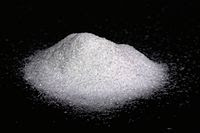
MSG (Wikimedia Commons)
Do you see the problem?  "Flavors" can simply be about what people, or the people of a country such as America, eat, whether that food is cooked by third parties in restaurants or shops or is cooked by the eaters themselves at home. But a cuisine is not simply, or even primarily, about what people eat; it's about what people choose to cook for themselves, when they do cook for themselves.  And Ms. Lohman's claim that these eight flavors are all flavors of "American cuisine" is less persuasive for some of the eight flavors than others. My annoyance came from my nagging suspicion that she had not made a good argument for showing that all eight of the flavors are truly "associated" with American cooking.

Ms. Lohman says, in her introduction:
But if I looked past these differences [in sorts of food made American cooks in different regions of the country], I wondered what united America's culinary culture?  I thought of rose water and vanilla:  rose water, at one time, was used all over the United States; and vanilla, regardless of a family's ethnicity, is consumed all over the country today.  I realized the key to defining American cuisine was to break it down to the basic flavors we all use, like vanilla.  (p. xv)
Vanilla pods
(Wikimedia Commons)
Ms. Lohman went on to reason, appropriately I think, that people learn to like particular flavors and that, once the preference is learned, it generally remains throughout life.  How to track what these preferences are, over time?  Ms. Lohman decided to do so by amassing a large collection of cookbooks published in America over the course of its history, examine the recipes for use of substances that provide particular flavors (based on how many times the words turn up in the books) and then graphing the results to determine which 8 "flavor" words are the most prevalent.  Thus Ms. Lohman arrived at her eight flavors: black pepper; vanilla; chili powder; curry powder; soy sauce; garlic; monosodium glutamate; and sriracha.

The problem with this method is that it assumes that cookbooks reflect what Americans actually cook, instead of, say, things that the cookbooks' authors want to encourage people to cook or to cook more often.  Early in America's history, when few cookbooks were published, it's a fairly reasonable to assume that recipes in cookbooks reflect, in a general way, the sorts of recipes made and the ingredients used.  As the number of cookbooks has increased, it's much harder to make that claim because a lot of American cookbooks over, say, the past few decades (I cannot speak to how early this trend began) are targeted to would-be cooks with particular interests:  owners of slow cookers; people looking for gluten-free or meatless recipes; or people seeking to emulate different non-American ethnic cuisines.

Soy sauce
(Wikimedia
Commons)
Put another way, the mere fact that a few cookbooks sold in America contain one or more recipes using a particular ingredient doesn't necessarily mean that a majority, or even a plurality, of Americans cook with it.  It's also a problem in that, once we reach the point in time at which cookbooks proliferate, one's attempts to divine characteristic American "flavors" will depend, directly, on how one selects cookbooks that are characteristic of American cooking.  And Ms. Lohman has not explained the basis on which she has chosen her cookbooks for Eight Flavors.

It may be easier for me to illustrate my view of the divergence between Ms. Lohman's recipe word analysis with some observations about use of each of her eight flavors in American cuisine. For two of the flavors, I agree with Ms. Lohman; they are definitely part of American cooking.  For two more, though there's more room for discussion, it's fair to say that they are probably part of American cooking.  Three more flavors have been intermittent, having gone in and out of fashion in American cooking, and the last one is only beginning to find a way into our cooking, even though it was invented here and is consumed in substantial amounts.  In writing this section, I have been influenced by my reading of cookbooks targeted at ordinary Americans, particularly mothers with busy schedules. The sorts of recipes featured by well-known blogger Stephanie O'Dea, are good examples of the sort of cooking I mean, even though she has an unusual interest in gluten-free cooking because she has children who cannot tolerate gluten for medical reasons.

DEFINITELY PART:  black pepper and vanilla.   I completely agree with Ms. Lohman that black pepper and vanilla are among the characteristic flavors of American cuisine.  Black pepper, though originally from Asia, had been part of European cuisine in England and elsewhere in northern Europe long before the Pilgrims sailed, and continued consistently to figure in recipes of all kinds while our young nation grew.  Today, there probably isn't a restaurant in America that doesn't have a shaker or grinder of black pepper on the table, and hardly a recipe in any cookbook published in this country that doesn't include the words "add salt and pepper to taste."
Curry powder, from Istanbul
(Wikimedia Commons)

Vanilla has a similar history.  It comes from a New World plant, but found its way to Europe in early modern times, and as Ms. Lohman tells us, European foods that use its unique flavor were imported back to America and became entrenched here.  Though vanilla does not turn up often in entrees and mealtime courses, it is very common in desserts of all kinds, particularly ice cream.

Huy Fong
sriracha
(Wikimedia
Commons)
PROBABLY PART:  curry powder and chili powder. There is a good case to be made for these spice blends as being characteristic of American cuisine, nowadays. Although Ms. Lohman acknowledges that Indian food, where the herbs typically included in curry powder originally came from, is not as popular as food from certain other lands, she has shown that spice combinations similar to modern curry powder have turned up in American cookbooks since the 18th century. More importantly, more recently curry powder has won itself a place in certain American dishes that have nothing in common with Indian cuisine other than the use of curry powder blends.  Mr. Lohman gives the example of country captain chicken, but in my opinion a more common, and thus for this purpose better, example is curried chicken salad, which turns up in a number of restaurants serving "American" style food and (undoubtedly) numerous recipe collections.  (The Wegmans supermarket chain sells a wonderful version of this dish that includes tofu at its food bars.)

Upon reflection, chili powder also qualifies.  After all, it was invented in the U.S. and made popular in Texas by the "chili queens" Ms. Lohman tells us so much about. Although chili powder mostly turns up in cookbooks as part of recipes for chili, a profusion of "chili" recipes has sprung up that is so varied as to practically count as a sub-cuisine in and of itself. Original chili con carne, consisting of chili-spiced beef.  Chile con carne, with beef and beans.  Chicken chilis and turkey chilis, with white beans.  Vegetarian chilis, with beans but no meat at all.  All of these contain chili powder.  Although I don't understand why Ms. Lohman did not generalize her claim to "red pepper" or cayenne, which appears in many various American recipes (and in Old Bay seasoning, which many Americans cook with), I'm disinclined to argue about the inclusion of chili powder in her "flavor" list.

INTERMITTENTLY PART:  garlic, MSG, and soy sauce.  In my opinion, garlic, MSG, and soy sauce all have a place in American cuisine, but it's a bit premature to think of any of the three as "characteristic" of American cooking, because they have not been consistently part of the broader American culinary scene.

Garlic is an interesting example.  Though a kitchen mainstay for thousands of years in some cuisines, such as those of China, Greece, and Rome, it did not find a place in early English cuisine, and thus a habit of using it did not come to the New World with the English in the way that the habit of using black pepper did.  Ms. Lohman chronicles how garlic was originally unpopular, in part because it was associated with lower-class immigrants and their cultures.   In our health-conscious culture of today, garlic is praised because of its health benefits, which probably accounts for much of its current popularity in American food.  As for recipes, onion is ubiquitous in American cookbooks (and on American tables), but garlic is much less so.  It is still held back from true ubiquity by its associations with certain immigrant cuisines, even now.
Homemade chili powder
(Wikimedia Commons)

Soy sauce certainly turns up a lot in American grocery carts, but it doesn't typically get used in "American" dishes such as chili or beef stew.  Instead, it is used on Asian, particularly Chinese and Japanese restaurant foods, and in home-cooked recipes based upon those cuisines.  You find it on the table as a condiment in American restaurants, but only those American restaurants that serve Chinese or Japanese food.

MSG, for the most part, is a good example of a flavor that's certainly present in American food (many Chinese restaurants in this country probably still use it), but it is not really a part of American cooking, undoubtedly due to the "controversy" about its harmfulness. Perhaps MSG sits on the table with the salt and pepper in Chinese American homes, but it doesn't have such a role in other American homes, despite the efforts of Wyler and others to sell it to American home cooks.  (For what it's worth, I have never suffered from "Chinese Restaurant Syndrome" and to this day have no clear idea what MSG on its own tastes like, though I used to have a container of Accent in my house.)

NOT QUITE PART:  sriracha.   The presence of sriracha in a book supposedly about American cooking feels forced, as though Ms. Lohman wanted to have an eighth flavor in the book mostly for symmetry's sake.  Sriracha is certainly a popular flavor, both on restaurant dishes and snack foods, but the only examples of cookbooks that contain sriracha recipes are quite new and targeted at adventurous eaters.

I can understand why Ms. Lohman did not want to write about sugar or salt; she's right that they turn up everywhere, and that quite enough has been written about them already. But there are other American tastes--common tastes--that do not turn up on her list, and I do not understand why.  Tastes like tomato (a prominent flavor in the chili con carne she discusses in Chapter 3) and tomato ketchup (found in most restaurants and homes throughout America, and, like curry powder, also an inheritance from the British/Indian influences on our cooking) and onion (I'm hard pressed to think of any soup or stew recipe that doesn't have at least one onion in it, and it's an integral part of a lot of American regional dishes, such as the Philly cheese steak).  

Nor is it clear why sriracha, a relative newcomer to the American scene, appears in the book when Tabasco, a much older hot sauce that often turns up in recipes and on tables in American restaurants, does not.  It might have been better to have grouped the capsaicin-based sauces together as an American flavor and to cite sriracha as the newest, most currently popular example of the breed.

Overall, what bothers me about Ms. Lohman's book was its confusion of the idea of popular flavors with whether use of those flavors and the condiments that produce them have become entrenched in American cooking.  But that confusion, assuming readers agree with me about it, is not a reason not to read Eight Flavors.  Whether or not you agree with my arguments above, Ms. Lohman's book has a lot of interesting information to offer, and a few intriguing recipes.  I enjoyed the book, and I'd recommend it as a fun read for anyone interested in the history of food.

EDIT: (9/11/2017)  Added the phrase "or even primarily" to the sentence "But a cuisine is not simply about what people eat; it's about what people choose to cook for themselves, when they do cook for themselves."  This states my thoughts a bit more accurately.

Tuesday, January 10, 2017

A Fast History of "Slow Food" and Other Diversions

A few years ago, my husband gave me a book from my Amazon wish list as a birthday present.  This was the book:
Gartenstein, Devra.  Cavemen, Monks, & Slow Food:  A History of Eating Well.  (Quirky Gourmet Productions 2011). 227 pages.
I had put this book on my wish list because I hoped the book would include some archaeological information, and educated speculation, about prehistoric food, as well as information tying in some of those speculations to what we know about food in the Middle Ages.

Sadly for me, that's not what this book really is about.  This book is simply a general history of the food of Western civilization, written clearly and elegantly, but with information taken almost entirely from secondary sources.  Moreover, the few sources that specifically relate to prehistoric food are books I already own and have read.  

I don't normally object to a book of popular history (of anything) for lacking footnotes, but the omission is annoying to me in this book because it makes it impossible for me to track down the sources for the few interesting facts cited by Ms. Gartenstein.

Curious about some of the odder characteristics of the book, I did a little bit of on line research about the author, and learned that Ms. Gartenstein is a chef and owner of a Seattle "food business" called the Patty Pan Grill, which, in her words "is a thoughtful, progressive food business committed to exploring creative approaches to eating well and living well. We're proud to be Seattle's oldest farmers' market concession, having provided hot, ready-to-eat food at outdoor events since 1997, when there were only two neighborhood markets in the city. Patty Pan sources most of our staples from the farmers who are our friends and neighbors at the markets."

In short, this is an interesting little book for someone with no background information about food history and no concern about whether the author cites information from strongly biased sources (which she does when discussing genetically modified foods and other modern food issues).  It is not, unfortunately, the sort of book I enjoy when I'm looking to expand my knowledge of food history.

Here's an example of the type of food history I do find worth reading. A little while ago, a friend and reader of this blog pointed me at a scholarly article called "Homegrown Cuisines or Naturalized Cuisines?  The History of Food in Hawaii and Hawaii's Place in Food History," by Rachel Laudan. The article is available on the publisher's website, but except during special promotions, it may only be downloaded for a fee.  Well-heeled and curious readers may find the relevant page here.

Ms. Laudan's work does include a fair amount of information describing the personal experiences that led her to research the subject, but she still gives an interesting presentation of the different sets of foodways that shaped the foods enjoyed in Hawaii today:
I would divide [Hawaiian cuisine] into four periods: the sacrificial cuisine of the Hawaiian Chiefdoms; the aristocratic cuisine of the Hawaiian monarchy; the republican cuisine of the plantation oligarchy; and modern cuisine, Local Food, of an American state.
The full citation of the Hawaiian food article is:
Laudan, Rachel.  Homegrown Cuisines or Naturalized Cuisines? The History of Food in Hawaii and Hawaii's Place in Food History, Food, Culture & Society:  An International Journal of Multidisciplinary Research, vol. 19, Issue 3, pp. 437-459 (2016).
Ms. Laudan's major point is that Hawaiian cuisine did not simply "evolve" on the basis of the foods available in the ancestral environment, but accreted partly based on locally available foodstuffs and partly on the basis of foods brought in and consumed by several different conquerors/ruling classes. It's a fascinating read, which I commend to my readers.


Monday, September 8, 2014

A Thoughtful Meal


Flatbread
Turnips
Recently, I obtained a copy of Daniel Serra and Hanna Tunberg's new book on Viking food.  The citation is: Serra, Daniel and Tunberg, Hanna. An Early Meal: A Viking Age Cookbook & Culinary Odyssey (ChronoCopia Publishing AB 2013).

Serra and Tunberg's book is beautified by a great many tasteful, full-color photographs of the stews, cheeses, breads, and other products of their recipes.  I have chosen to illustrate this review of their work with Wikimedia Commons images of foods that were commonly eaten in Scandinavia during the Viking period.  

Like other such books on Viking cuisine, the conclusions propounded by An Early Meal are grounded in deductions based on archaeological finds as to the foods, cooking techniques, and cooking vessels available in Scandinavia during the Viking period.  But Serra and Tunberg have taken a much deeper look at the available evidence than other books on the subject that I have read.  Unlike the other books, they have gathered much more information, and analyzed it more comprehensively, taking into consideration not only the food stuffs and cooking technology available to the Vikings, but also the seasons of the year during which particular foods would have been obtainable.  Then they considered these questions in terms of the different conditions extant in different major settlements of the Viking world--Lofoten, Kaupang, Lejre, Hedeby, Jorvik, Uppakra, and Birka.  The result is a more detailed proposed recreation of Viking cuisine that takes into account regional differences and is consequently more convincing than any other recreation of which I have read.

Cod
Haddock
Although I have a general familiarity with the archaeological discoveries relating to the foods that were eaten in Viking age Scandinavia, Serra and Tunberg discuss some critical considerations that had not occurred to me, and that lead to conclusions that I, at least, found surprising.  The conclusions that surprised me include the following:

The hungriest time was summer.  We are accustomed to thinking of summer as a time of plenty. But that is because we can always import foods from areas where "harvest" comes earlier or later than it does for us, ensuring a fairly constant food supply (and a great variety of different types of foods) year-round.  Serra and Tunberg point out that most of the Vikings' food supply was local, and peaked in the autumn--which was when the cereal crops were harvested and food animals that could not economically be fed during the winter were slaughtered.   Although some food items, such as green herbs and berries, became available in spring or summer, they would not be sufficient to feed a hard-working populace, and milk had to be taken carefully, to avoid starving the animals' young and thus diminishing future meat sources.  Perhaps the answer to the question in my last post, "What did the Vikings eat during the hottest days of summer?" was simply "very little."  Or maybe the answer was "fish"--since ocean fishing and river fishing likely would have been an option, and might not have left many traces in the archaeological record.
Thyme
Kale
Sweets were rare. Serra and Tunberg note that apiculture did not seem to exist in Scandinavia during the Viking age, either because of ignorance of the relevant techniques, or because bees did not survive the winter months in such a cold climate.  Thus honey was an imported good (the authors speculate that it may have been imported from the Baltic countries) and when imported was probably used primarily to make mead rather than for sweetening everyday food. The authors point out that other than fruits (many of which were more tart than sweet), the malt remaining from the beer brewing process, and imported honey, there were no sweeteners available in Viking age Scandinavia.
Meats were eaten preserved more often than raw.  If most slaughtering was done in the autumn to conserve food resources to last through the winter, spring and summer months, it follows that most meat was preserved in some fashion. The authors propose that meat may have been pickled in whey, or in salt, or even smoked to preserve it.  Whatever means were most commonly used to preserve meat, the point remains that cooking and eating freshly killed meat (other than perhaps fish) was not a common occurrence.
Butter (Borough Market, London)
Angelica 
Game was eaten much less often than one might think.  My husband's first thought was that hunting could have obtained game animals, providing fresh meat for Viking age tables. But that game meat would have to be butchered and prepared for table somewhere, and Serra and Tunberg report that surprisingly few bones from game animals have been discovered by archaeologists in the vicinity of period settlements. Perhaps there simply was not enough small game in Scandinavia to make snares and small game hunting a profitable enterprise, and large game animals (such as reindeer) would be challenging, if not impossible, to butcher and preserve if killed during the hungry winter and early spring months.
Frying was limited as a cooking technique.   The authors note that most cooking was done in iron cauldrons or heavy soapstone (or in some parts of the area, ceramic) placed in proximity to a fire. Such equipment would allow for slow sauteing of onions, ramsons or leeks (and many of the recipes in An Early Meal make use of this technique), but would not cook meats effectively.  
Consideration of these techniques leads inevitably to the conclusion that the dominant flavors in Viking cuisine, as in Scandinavian cuisine today, are sour ones.  Yogurts and cheeses were popular with the Vikings as they are with their descendants, though they were much more important for the Vikings because they provided a means to use milk long after the liquid product would have spoiled. Serra and Tunberg observe that whey likely was used served to preserve meats, which would give them a sour taste also.   Vegetables such as kale could also have been preserved by pickling. Even the berries and crabapples most commonly eaten by the Vikings were tart rather than sweet.

I have long been fascinated by the material culture of Viking age Scandinavia, but it had not occurred to me before how very different their foodways were from the ones familiar to me. I don't mean the scarcity of fried foods, the shortage of sweets, and the large number of sour-tasting dishes--though those are important differences.  But an American living in the 21st century CE does not have to follow the seasons very closely in choosing food.  The Vikings had to do so as a matter of survival, and the variety of foodstuffs available to them was small by comparison to what I can buy inexpensively at my local supermarket just a few miles away.

I was even more forcibly reminded of the vast cultural difference between us and the Vikings when I attempted to select a recipe from An Early Meal to feed myself and my husband--but that's a matter for another post.

Wednesday, July 2, 2014

Flatbreads

Shortly after I'd read Serra and Tunberg's book An Early Meal, I followed a link from Katrin Kania's blog, A stitch in time, to an article about a food writer who has been experimenting with recreating ancient flatbreads.

The author's name is Paula Marcoux and her book is called Cooking With Fire.  Her book is very different from Serra and Tunberg's.  Instead of working primarily from the evidence of foodstuffs and kitchen equipment, Marcoux focuses on the actual physical techniques of early period cooking--details such as how to build a proper cookfire and how to make the stone-lined pits Serra and Tunberg discuss--and teaches the reader how to perform those techniques.  The link Katrin provided was to an article about Marcoux's book on io9, but you can read a better article about Marcoux's work here, at SplendidTable.org.

In the Splendid Table article, Marcoux describes her version of a Scandinavian flatbread that Vikings might have made:  she calls it  Protohistoric Multigrain Flatbread, to poke a bit of fun at archaeologist pretensions. Marcoux devised this recipe from remains of carbonized bread found in Scandinavian cremation graves.  She observes:
When things are burned, they are often partially burned, lightly carbonized, and that preserves grain extremely well. Archaeologists have been able to determine exactly the components and shapes of these flatbreads, which I found entirely fascinating. Once I'd learned what types of grains they were made of, the types of fats that were in there, the shapes of the grains, the shapes of the flatbreads, there's nothing more to it -- that's basically a recipe.
I picked out a few of my favorite combinations and made them. It turned out they were really delicious, they keep very well and they are fun to make. You can leave a little hole in the middle, string them up and they keep for ages -- that's how people in Scandinavia used to keep their grain crop. If they kept the grain in its own natural state, it would go moldy or get mildewy. But if they made it into bread right away and then strung it up in their houses, it would keep for the entire season until the next harvest time
Although I'll put Marcoux's book on my wishlist, her Protohistoric Multigrain Flatbread recipe can be found here. It's made from a combination of oats and rye flour. I may give it a try, as best I can manage in my kitchen, on a gas stovetop with just a skillet. If the taste is appealing enough, I may invest in a long-handled griddle of the type the Vikings reputedly used to make flatbreads, hoping to have an opportunity to cook them over a fire sometime.

Wednesday, April 9, 2014

EXARC on "An Early Meal"

I have not yet succeeded in reading, let alone obtaining, a copy of the latest book on Viking age Scandinavian food, "An Early Meal", but there's an interesting review of the book on EXARC, a journal of experimental archaeology. The review can be read here. The gist of the review is that the recipes produce extremely good food. It has made me even more eager to obtain a copy.  

Sunday, December 15, 2013

Carolingian Food

Fava beans!*
I recently acquired an SCA "Compleat Anachronist"  booklet called "Carolingian Foodways" by Volker Bach.  For $4.50 USD this booklet, which can be purchased from sca.org, is an unbeatable way to satisfy one's curiosity about a period whose cuisine receives little attention, and a good start for anyone interested in undertaking more detailed research on the topic.

The best way to demonstrate why I respect this little booklet so much is by discussing the various things Bach has done right that the authors of many historical food treatises and cookbooks ignore, or get wrong.   "Carolingian Foodways" is immensely educational because Bach provides the reader not just with known facts, but with the following tools to assess them:

1.  A discussion of the limitations of available historical sources.  A historian researching the material culture of a place, time and period such as the Carolingian Empire must begin by realizing that there will be relatively few writings among the available sources of knowledge and the written sources that do exist must be evaluated and assessed with care to avoid misinterpretation.

Bacon!
Bach begins his work with a good primer that discusses the major written sources we have for Carolingian food, and their limitations.  Three sources of what we would think of as recipes existed in the Carolingian era:  Apicius's recipe collection; a manuscript called the Collation of Vinidarius, and the letter of Anthimus.  Apicius's work dates back to early Rome; the Vinidarius work is of disputed date, but its recipes likely date to several hundred years before Charlemagne, and Anthimus' work is not so much a cookbook as a letter of medical advice written for a king in the 6th century C.E.  More importantly, none of these works were written during the Carolingian period.

Of course, the lack of recipe books does not mean there was no cooking or cuisine, and Bach describes a number of other sources from which information about the foods of Charlemagne's day can be derived.  These include literature, law texts, and administrative documents.  Charlemagne himself composed a treatise, known as the capitulare de villis, which describes how he desired his estates should be run, which gives precious insight into what items were standard equipment for the operation of kitchens and gardens of a wealthy estate.  Surviving plans for the monastery of St. Gall give similar insight for how a large monastery operated to feed its brothers, as well as the wayfarers and noble guests who were often fed and given temporary housing at monasteries during the period.   Finally, archaeological evidence (animal bone finds, utensils, cooking containers, hearths, etc.) helps with the interpretation of the evidence from written sources.

Onions!
In short, deducing the form and content of Carolingian cuisine is like assembling a jigsaw puzzle with an unknown number of pieces missing and without the picture from the lid of the puzzle box.  Reading Bach's description will help the history novice appreciate that the task of historians is often much more complicated than looking up information and transcribing it.

2. A discussion of the physical and cultural limitations that shaped cuisine.  Cuisines are shaped by a number of factors.  The most obvious of those factors are the foods available to cook and eat and the technologies available to use in cooking them. The available foods issue is more than just a question of what foods are native to the Old World, as opposed to the New World; it requires some consideration of what foods would be easy to obtain in the parts of Europe that Charlemagne incorporated into his empire and what foods would be hard to find. 

Although the written sources for Carolingian food are biased in favor of what the well-off might eat, Bach also attempts to deduce the basic diet of the common man, and concludes that it must have featured bread (typically made from barley and rye), porridges made from the same types of grains as the bread, fava beans, peas, cabbage, onions and leeks, butter and cheese, with beef and pork as an occasional meal and/or in small amounts for flavoring.  The picture for the rich is much the same, except the bread would be made from wheat, meat would be more common, and chickens and eggs make an appearance.  Fish would have been available and eaten by people of all classes who lived in areas close to rivers and coasts.   Both rich and ordinary folk could well have used herbs to flavor foods, with the common man limited to what could be gathered locally while the rich could import some items.   Mustard and garlic appear, as well as green onions and other familiar herbs (e.g., dill, thyme, sage, rosemary); some of the herbs were more likely to appear in the Mediterranean reaches of the Empire (e.g., rosemary) because they were native to those areas.

Barley!
Available cooking technologies are in some ways easier to deduce, since whatever references appear in the written sources can be cross-checked against the types of cooking equipment found and dated by archaeologists.  Bach notes that the most common food preparation technique was boiling, and for most people food would have been boiled in a clay pot instead of a metal one.  Cooking in a clay pot is different from doing so in the metal pots and pans that are common for us because high temperature cooking is largely impossible, particularly since the heat source was an open fire.  According to Bach, "Cooking food at a rolling boil is almost impossible in them [clay pots], and their results are best replicated by gently baking a cooking container or cooking on a gentle heat.  You can fry foods in a clay pan, but you don't get the same sizzle as you would in metal."  (p. 26).  Metal containers were likely the province of kitchens that fed large houses, such as monasteries and the manors of the rich.

The other shaper of cuisine Bach discusses is the possible influence of Roman cuisine.  Did the Carolingians still use garum?  Did they retain the Roman enjoyment of green salads?  Bach argues that they probably did, based in part upon how contemporary figures referenced Roman examples in writing about their own food experiences.   To give Bach further credit, he does not simply fall back on the clichéd assumption that cultural trends did not change as rapidly in the distant historical past as they do now; instead, he attempts to base his inferences on written sources or known facts.

3. An explanation of intellectual biases that affect the author's treatment of his subject.  My estimation of Bach soared when I read the section in his booklet that discusses the two conflicting approaches to the recreation of Early Period material culture (including, of course,  food).  The two basic approaches are the minimalist and the maximalist approach.

Mustard! (seed and condiment)
The minimalist approach is more frequently taught to archaeology and history students, and colors most people's perception of earlier times.  Motion pictures, in particular, base their view of the past upon minimalist assumptions.  Under the minimalist view, everyone, including the rich, was extremely poor by modern standards; they were dirty and often starving, and all, even the rich, dressed in coarse, drab fabrics.  This view tends to prevail despite the fact that archaeology sometimes finds evidence that at least the rich wore finely woven cloth and  exquisitely crafted jewelry, and ate a varied diet, and that even the European peasant diet of the the Middle Ages was quite healthy by modern standards.

Maximalists, as one might deduce, take the opposite view of the known facts.  For example, they tend to assume that the jewels and the fine fabrics found by archaeologists were, if not common, at least normal for some people.  Bach gives this example:  "Their aristocrat would be dressed in silk and colorful woolens, with a carefully tooled and dyed leather belt holding up the polished sword and a warshield painted with Egyptian blue and Spanish cinnabar." (p. 25)  The problem with this picture, Bach observes, is that "None of this is impossible, but we also can't be sure it ever was combined this way."  (p. 25)

Bach describes himself as "a confessed maximalist, although a cautious one".   His interpretation, as I have sought to describe it above, is one where most people got enough to eat of simple foods (such as those shown in the photographs accompanying this post), and the rich enjoyed some additional luxuries.  That doesn't strike me as a maximal position, merely a sensible corrective to the assumption that a starving Europe managed to give birth to vigorous peoples who eventually created empires even larger than Rome.

Cabbage!
4.  Plausible historical recipes that can be made by the interested.  No matter how sophisticated one's understanding of the difficulty of recreating the cuisine of a culture where there are few if any surviving cookbooks, it is still a disappointment to read a book about historical food that doesn't take the leap of faith and present at least a few recipes that seem plausible in light of the available foods and cooking techniques.

Given Bach's identification with the maximalist school of archaeological reconstruction, I was surprised to see how conservative his suggested recipes are.  One of them, a bean recipe that in its simplicity reminds me of ful medames, inspired me to conduct an informal experiment that I plan to write about in a later post.  Here is the recipe:
250 g/ 1/2 pound dried fava beans
50 g bacon
Water
Salt
Optional:  Butter or other fat, vinegar, mustard

Wash the beans and soak them in cold water overnight.  The next day, heat plenty of unsalted water in a pot and cook the beans for 60-90 minutes until they are soft.  Cooking times can vary a great deal, so always make sure to test your beans.  If any float on top of the boiling water, discard them--they are probably wormy.  Once the beans are cooked, pour off the cooking water, add a little fresh water, salt and bacon and let the beans absorb the flavor at a gentle heat for 10-20 minutes, making sure they don't burn.  If you leave the bacon in, or the piece was on the fatty side, you won't need to add any butter, but a dab of it added before serving can improve very plain beans.  Vinegar or mustard can be added as seasonings.  (p. 47)
5.   Good endnotes and a full bibliography.  It is irresponsible for a historian to set forth the conclusions of his own research without including references to the sources upon which it is based.  Bach is not irresponsible; he provides his bibliography, which includes sources available on the Internet and extends into culinary history both from before and after Charlemagne's day.  The sources (some of which I recognize) make an excellent education in the cuisine period as well as providing some understanding of some of the history that shaped it.

There is so much information packed into "Carolingian Foodways" that as I write this I'm finding that I need to read the entire book again, to assess and consider details I have overlooked.  Fortunately, that's no hardship; the book is well-written and a pleasant read.   This short, crude summary of his work hardly does the book justice.  I urge interested readers of this blog to obtain a copy, peruse it for themselves, and think about how the shape of Carolingian life both enabled and limited the forms and flavors of its food.** 


*   All photographs in this article from Wikimedia Commons.

**  I apologize in advance for any errors I may have made in this summary, particularly any errors that may give an incorrect impression as to Volk's conclusions. 

Thursday, May 23, 2013

An Early Meal

As my readers will recall, I am very interested in the material culture of Scandinavia of the Viking age, and have reviewed two different books about "Viking" cuisine for this blog.

This year, another English language book on Viking cuisine is being published. One of its co-authors is Daniel Serra, who writes the Eldrimmer blog. The book is called, An Early Meal: A Viking Age Cookbook and Cultural Odyssey, and it's being published by ChronoCopia Publishing. ChronoCopia's page on the book, which you can use to track information about when and where and how to obtain a copy, may be found here.  The book's Facebook page is here.  Go here for an inside peek into the table of contents and a few other pages of the book.

An Early Meal, like the other Viking age cookery books I've read recently, is a history book as well as a cookbook. It takes a more interesting perspective on its subject by attempting to recreate recipes based upon archaeological finds from particular Viking sites, rather than creating an amorphous, and potentially misleading, generic "Viking" cuisine. The sites involved are Lofoten (Norway), Kaupang (Norway), Lejre (Denmark), Hedeby (Denmark), Jorvik (Danish settlement in England), Uppåkra (Sweden) and Birka (Sweden).  Thus, the authors' book gives an idea of what regional variation must have existed in Viking fare.

Handelsgillet.com, a Swedish business catering to reenactors, is selling the book for 360 Swedish kroner, which is about $54.00 USD, before postage. I'm hoping that Potboiler Press, which is planning to sell the book in the US, will be able to provide me with a copy at a lower price, since I am eager to read the fruits of the authors' research and learn how Viking age cooking differed in the various regions of Scandinavia. If I do manage to obtain a copy, I will review it here. If any readers obtain a copy first, please comment about it here.

EDIT:  Potboiler Press has told me that their price for the book will be $40.50 USD before shipping.   Hopefully I can get a copy eventually.

Sunday, January 13, 2013

Apocalypse Chow

Happy New Year!

In light of Hurricane Sandy and the so-called Mayan Apocalypse, it seems appropriate to discuss a book about how to eat well when your world appears to be ending.

A friend of mine provided me with a copy of the following book as a Christmas gift:
Robertson, Jon with Robertson, Robin. Apocalypse Chow: How to Eat Well When The Power Goes Out. Simon Spotlight Entertainment (2005).
The reason I had not purchased the book for myself is that I had read enough book reviews on Amazon to have learned that all of the recipes in it are vegetarian. Since my husband concluded long ago that he could not get enough calories to live, let along be satisfied, by a vegetarian diet, I figured that Apocalypse Chow would be of little practical utility for me. I remained curious about the book, however, and was pleased when I received it as a Christmas present, since that meant I would have a chance to gratify my curiosity about its recipes and recommendations.

Unfortunately, the book's title turns out to be a misnomer. Its use of the word "apocalypse" implies that the advice in the book is of use for any kind of emergency where it is necessary to feed oneself with limited access to food shops and electric power, but in fact that isn't true; its advice is really only practical in situations where you may be without electrical power, but are in a relatively safe location and power is likely to restored within a few days.

This can be seen from the advice the Robertsons give, and the types of recipes they provide, even leaving aside the issue of their vegetarianism.  The book reveals its focus on the short-term emergency most explicitly with its prescription for a "Five-Day Menu".  This is a list of items you can make, and that will feed several people for five days and can be made with the canned goods and miscellaneous items you can fit into a wine box.  This is a great idea if your neighborhood, like mine, suffers from brownouts during the summer (a point the Robertsons allude to at the very start of the book), but it doesn't get you to first base in doing long-term disaster planning.

And the recipes themselves aren't necessarily practical for situations where both power and water supplies are limited.  For example:
  • Quick Quinoa Pilaf (p. 139), which requires rinsing the quinoa (a South American grain) "well to remove the bitter white coating". Cooking anything that requires much rinsing is unlikely to be practical when water supplies are limited.
  • High-Road Lo-Mein (p. 136), which calls for a can apiece of water chestnuts and bamboo shoots, along with 12 ounces of "Chinese noodles." Most people don't stock up on water chestnuts or bamboo shoots, and it's not at all clear what is meant by "Chinese noodles." Certainly not ramen, which is a Japanese product (and the book uses the word "ramen" when its use is intended).  However, noodles typically require substantial water to prepare relative to the amount of food they generate.
  • Happy Granny's Ginger-Walnut Rum Balls (p. 201), which require you to combine cookie crumbs with sugar, maple syrup, and rum and shape balls from the mixture. Getting your hands sticky when water supplies are limited is not a great idea.
That brings me to the element I found to be the most annoying about the book.  It's simply not written for the average American, since many Americans lack the kind of money required to sink into preparing for a catastrophe by obtaining the resources the Robertsons have in mind.  For example, the book discusses MREs (i.e., "Meals Ready to Eat", originally made for the military, but more generally available--at a price) and freeze-dried foods (which require hot water to reconstitute them, again posing an issue in a true emergency), options even the authors admit are expensive.

To be fair, Apocalypse Chow's recipes primarily rely upon what the authors call SRE's--Supermarket Ready to Eats.  These are things like canned vegetables and stews and packaged rice mixes.  Although these items can be easily obtained by the average American, obtaining them in large quantities starts to get expensive also.

What will you cook the Robertsons' cuisine on? The Robertsons fall back on "a single-burner butane unit that chefs use for demonstrations." These cost between $50-$100 USD; the butane canisters they need are "inexpensive and can be purchased by the case". Once again, however, they are a short-term alternative.  The authors tell us that they keep a case of a dozen cans of the stuff in a closet for emergencies "enough to keep us cooking for several weeks". Still, the practicality of this approach as an alternative is speculative at best--particularly if your household consists of more than two people.

Worse than the dubious practicality of some of the Robertsons' advice is the cultural gap implicit in it. Their idea of appropriate canned goods for an emergency is things like canned artichoke hearts, chickpeas, and green beans. The recipes require spices and things like sun-dried tomatoes. Indeed, they feel impelled to apologize for the fact that the dishes in this book are not made with fresh foods--as though it was a given that fresh foods would be available in any kind of true emergency. And their advice on how to deal with emergency-caused stress include experimenting with napkin-folding and table settings, and reading about other disasters and other books that are truly strange.  (The Statistical Abstract of the United States? Really?)

The entire book zigzags back and forth between giving genuinely useful advice (such as how much water and food to provide per person during a disaster, and items to include in a disaster-planning kit) and giving advice that borders on the silly (serving your made-from-cans emergency sandwich spread on "classy crackers"!). I'm torn between admiring the Robertsons' determination to view scary emergency situations with cheer and humor (a very good idea) and their apparently total inability to understand that a lot of their recommended foods and equipment items include things that the average American probably couldn't stomach (canned vegetables of all types) and might not be able to acquire quickly.  An emergency is no time to experiment with foods you might not like, because having a ton of food you cannot force yourself to eat is the worst of all options.

I've concluded that Apocalypse Chow is a curiosity, of the same kind as a talking dog; i.e., the most surprising thing about the book is that it exists and has a market at all. Read it, think about the situations the authors describe and how you could handle them with your budget, maybe even try out some of the recipes (when you *have* power) to see whether they might work for you and your family.  Just don't assume that having a copy of the book, along with a pantry full of canned veggies, will prepare you for the Apocalypse, because it won't.

Sunday, November 25, 2012

Renaissance Cooking--Alice's Way

A friend of mine recently sent me copies of three booklets on Renaissance food authored by Anjila K. Olsen, otherwise known as Alice the Cook, who I understand is a popular figure on the Minnesota Ren Faire circuit.  They are titled simply "Renaissance Cooking", "Renaissance Cooking II: Visiting the Silk Road", and "Renaissance Cooking III:  Illustrated Renaissance Cooking."  They are small pamphlets, each no more than about 40 pages in length.  They consist primarily of recipes, with an occasional short essay thrown in about cooking techniques, or the origins of a particular dish.  So far as I know, Alice only sells the pamphlets at the Ren Faires where she performs, though she might be willing to mail them to interested parties who contact her through her website.

I devoured (pun intentional) these pamphlets eagerly.  Having read through them, however, I have mixed feelings about them.

On the other hand, just about all of the recipes in the books appear to be marvelously tasty, and I plan to try out a number of them.   They include a large number of savory meat stews and soups, often flavored with bacon and fortified with root vegetables--exactly the kind of thing I make for dinner for myself and my meat-loving husband.  In particular, the meat hashes (e.g., the sausage and bacon hashes) would make a great meal for any meat-lover.  Moreover, these hash recipes could easily be adapted to vegetarian use, either by substituting seitan or a soy protein for the meat, or by adding portabello mushrooms or another "meaty" vegetable.

On the other hand, from the point of view of someone, such as myself, who is more interested in the history of food than in cooking, these booklets are less than satisfying.  They contain no bibliographies or even  references to particular historical sources.  More disappointing (at least to me) is that most of the recipes in all three booklets contain potatoes and/or sweet potatoes--both New World plants that, at best, would have been hard-to-come by during the Renaissance in Europe.

The lack of background sources is particularly irritating to me with regard to the instances where Alice discusses a subject I didn't previously know about. For example, on the subject of "hashes", which Alice correctly defines as "simple one-pot dishes that combine meat ... with various root vegetables to create a hearty meal," Alice states that hashes are traditionally English in origin, and began as a kind of meat-less vegetable stew prepared and eaten by the lower classes (at least during the 14th century); meat became part of these stews later. This sounds like a very plausible origin story, but it doesn't quite square with the following statement from the Food Timeline:
The idea of hash (pre-cooked meat cut up into tiny pieces and simmered/fried until tender with or without vegetables and spices) dates back into ancient times. Ancient Romans composed similar dishes of various sizes and composition. Food historians tell us minced meat dishes of various sorts were quite popular in the Middle Ages. Mutton, a traditionally tough meat, was often used. Beef, veal, and venison were similarly rendered. Corned beef hash was inevitable.
The Food Timeline goes on to report that some believe that hash, in the modern sense of a stew of chopped meat with chopped root vegetable,s arose in the 17th century because of some remarks made by Samuel Pepys in his famous diary.

So was hash always made with meat?  Was it commonly not made with meat during certain periods (such as 14th century England) and not others? Nothing that Alice (or, the Food Timeline, for that matter) says gives me a direction in which to dig to satisfy my curiosity on this point.  That's frustrating to me.  In my opinion, a tasty dish is even more enjoyable if you understand how far back in time it was enjoyed by other people.

To be fair, Alice openly acknowledges that a number of her recipes are not strictly period. For example, in "Renaissance Cooking III", she notes, with regard to a recipe for Orange Rosemary Chicken:
I realize that potatoes were brought to Europe with the discovery of the New World and were not commonly used; they have been added as a suggestion to this recipe for the modern American and European tastes.
It's my belief that Alice given so many of her recipes "a modern twist" (to quote the Introduction to "Renaissance Cooking II") and limited the amount of history in her booklets to avoid scaring away ordinary people who know little if anything about the history of cooking and food.  I think that's unfortunate, because the booklets tend to give a careless reader the impression that Renaissance-era Europeans routinely used potatoes and sweet potatoes in their cooking--which is not true.  But maybe I'm being too harsh.  If the booklets induce people to be a bit more curious about the origins of their food, and a bit more willing to experiment with novel recipes or novel means of food preparation, they will have accomplished a public service.  Never having visited the Minnesota Ren Faire, or otherwise watched Alice at work, I can't say how successful she is at getting ordinary people to be more experimental or to think about how other folk in earlier times have approached the issue of making tasty food.

Wednesday, October 10, 2012

A Cook's Appetites

A few months ago, an old friend of mine gave me the following book as a belated birthday/holiday present:
Thorne, John with Thorne, Matt Lewis.  Mouth Wide Open: A Cook and His Appetite.  North Point Press (paperback ed. 2008).
Any of my readers who are fascinated with food may well have read this book or one of the other half-dozen or so books Mr. Thorne has published over the years. Mouth Wide Open fits pretty well with the theme of this blog, because one of its subthemes is the evolution of recipes, both historically and as Mr. Thorne has attempted to prepare them, though the book is not a culinary history. The book contains a number of tasty-looking recipes, though it is not a cookbook either. And although Mr. Thorne writes, at great length, about his personal experiences with cooking, food, and weight gain, this book isn't really a memoir.

Mouth Wide Open is a gentle but firm exposition of Mr. Thorne's philosophy about cooking, described against the backdrop of his personal experiences with cooking and food.   Mr. Thorne's philosophy is that cooking is (or at least should be) more than a mechanical process of following printed recipes; it should be a process of learning about how foods behave under different preparation methods, how they combine with other foods, and how to use that information to produce dishes that can be eaten with enjoyment.  In Mr. Thorne's view, cooking is also a sensual process, because all of the senses have information to provide about whether a dish is being prepared "right".  (And also because, in his view, cooking is more fun that way.)

Ever since I finished Mouth Wide Open, I've been struggling to put my finger on why the book was interesting to me.  Although I enjoy my food, and I find the whys and wherefores that lead people to eat and cook certain foods interesting, I don't enjoy the actual process of cooking very much. To me, cooking feels like too much work for way too little enjoyment. The final insult is that after you've finished, you have to clean the pots, dishes and pans, and the kitchen too! In fact, you have to do some cleaning after every meal--unless you eat out, of course. So although I've learned to cook well enough to feed myself and give enjoyment to other people, I don't relish the physical experience of cooking.

Having pondered the matter for quite some time, I think that what I found appealing about Mouth Wide Open is the fact that it is not just about food, or the appetite for food.  Mr. Thorne has many different appetites, judging by what he has written, and he discusses all of them in an easy, fascinating way. For example:
  • An appetite for knowledge. In an essay called "Have It Your Way," Mr. Thorne writes very intelligently about the well-known expose, Fast Food Nation, tracing Eric Schlosser's description of how the evolution of the American fast food industry has gone a long way toward making Americans fatter.  Mr. Thorne also provides some powerful personal insights as to how the fast food phenomenon affected him personally; insights that suggest new ways of looking at the problems Schlosser discussed.  (pages 331-352)
  • An appetite for experimentation.  This appetite is not only implicit in Mr. Thorne's main theme--that cooking should be an experimental process--but also in his account of having sauteed, and eaten, spinach stems (pages 318-319), and of making and eating a cilantro sandwich (page 323), and from his description of what it was like to eat a five-month-old croissant (page 177).   
  • An appetite for sensation.  Mr. Thorne describes with impressive power the sensual aspects of eating unusual foods such as the marrow of beef bones (pages 4-6) and beef kidneys (pages 169-170).
  • An appetite for the familiar.  Mr. Thorne loves eating foreign foods, but he retains his fondness for the foods he learned to love as a child and young man, even the ones he later learned were "second best", such as (American) Chinese restaurant glazed spare ribs (pages 156-157).
  • An appetite for the exotic.  Mouth Wide Open features mini cultural histories of a wide variety of dishes, including (but by no means limited to) marmalade (pages 41-57), falafel (pages 181-197), minestrone (pages 109-124), satay (pages 208-227),  and Chinese fried rice (pages 154-166).
  • An appetite for thrift. "I find it hard to shake the idea that I ought to eat all the food I buy to make a particular dish, or at least save it for another day.  This means that there are many dishes I wouldn't even think of making, even once, out of mere curiosity." (page xxxii).
The real charm of Mr. Thorne's book is that he isn't just "writing about food." He's telling stories--about his life, about the development of recipes, about eating, about learning--and those recipes give the reader a very strong sense, by the time the book is done, of having spent a week with the man and come to know *him* to an impressive degree.  I don't know of any other food author of whom that can be said.

And the John Thorne one gets to know by reading this book is a very likeable guy.  I'd give him my spinach stems any time (especially since I detest the darn things).